Bringing Blueprints to AI Music Production: A Strudel + Claude + Suno Workflow
The Limits of "Make Me a Cool Song"
Many of you have probably typed something like "make me a cool song" into Suno.
You get a decent track. But something feels off. You regenerate. Still not quite right. After a few rounds, you settle for "good enough."
This is like asking an architect to "build me a nice house" with no blueprints. A different house shows up every time. They're all "nice," but none of them are the house you actually want to live in.
So why not draw the blueprints first? Well, here's the problem: drawing musical blueprints requires musical knowledge. What's a chord progression? A scale? How do you design a rhythm pattern? Without this knowledge, you can't write a good blueprint.
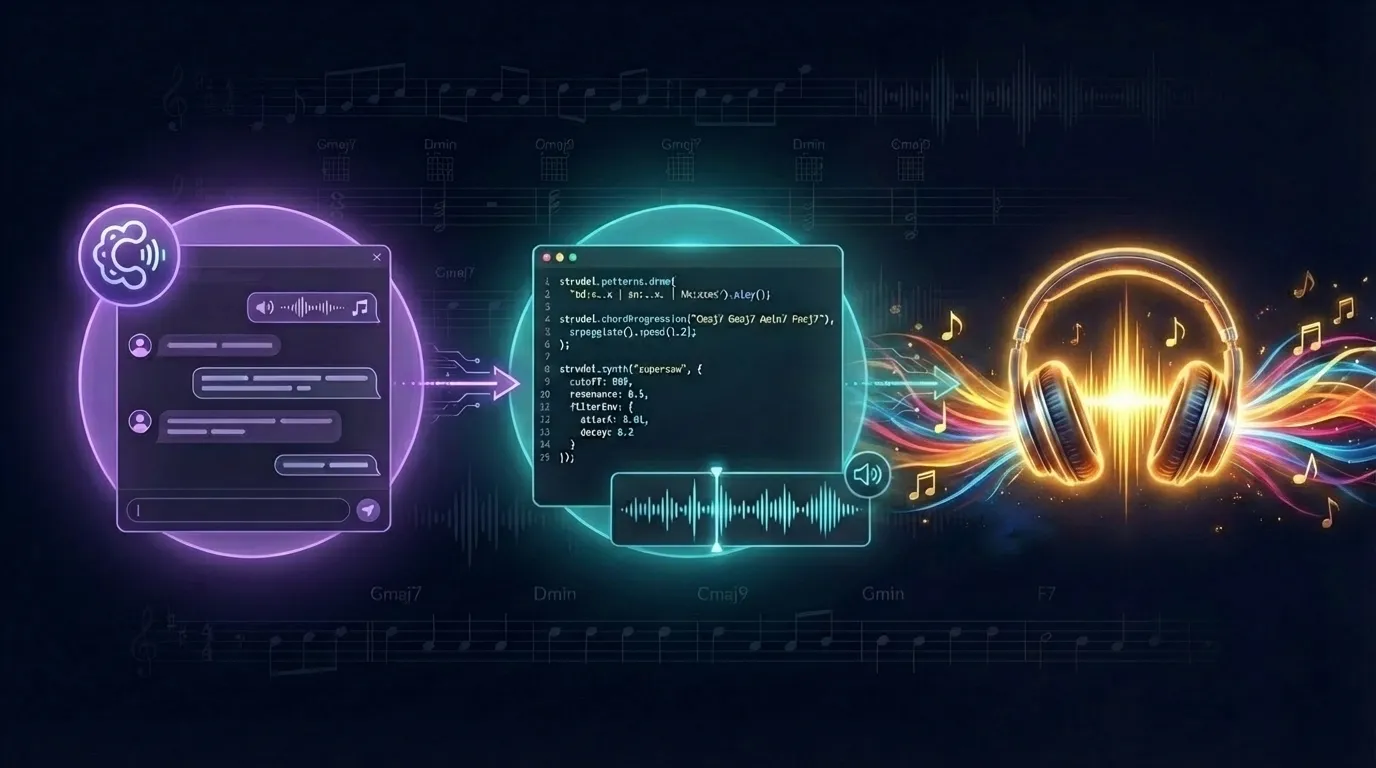
This is where conversational AI like Claude comes in. You can use the musical knowledge inside AI to build the blueprint together. Then you refine it by auditioning it in Strudel, a browser-based programming environment that plays sound instantly.
Using Two AIs for Two Different Jobs
The key is using AI in two stages.
① Claude × Strudel to create the blueprint
② Hand that blueprint to Suno to generate the final track
Claude is "a musically knowledgeable advisor," Strudel is "a studio where you can hear sounds instantly," and Suno is "the factory that turns your blueprint into a finished song."
What Claude Does for You
Translates "bright song" into musical language
You: "I want to make a bright festival song"
Claude: "How about D major I-V-vi-IV? It's a staple for festival anthems. F major would lean more tropical, C major more classic pop."
You only said "bright." But Claude translates that into "D major, I-V-vi-IV." All you have to do is pick.
Turns "something's off" into your next options
You: "The bass sounds boring. I want something cooler."
Claude: "Fretless bass for a smooth feel, acid bass for a squelchy texture, upright bass for acoustic warmth — which direction sounds closer?"
Claude breaks down a vague word like "cooler" into concrete choices. You pick one, hear it in Strudel, and if it's not right, Claude offers something else. This process of exploring through conversation is a completely different experience from Suno's slot-machine-style regeneration.
Breaks down reference tracks for you
Say "something like that famous song," and Claude will look up its chord progression, BPM, key, and genre characteristics. Work that would normally require music analysis skills and research time gets done in a single conversation.
Writes lyrics that fit your track
Claude can write lyrics while understanding the mood of your chord progression. Bright major key? Uplifting, open lyrics. Dark minor key? Aggressive, driving lyrics. And you can refine line by line — "this line's rhythm feels off," "make it more about togetherness" — through conversation.
What You Define in Strudel
Strudel is a browser-based music programming environment. You write code, and it plays sound instantly. Here's what you define:
Drum and rhythm patterns
You specify exactly which percussion hits at which timing, note by note.
s("bd*4")                                    // four-on-the-floor kick
s("~ [~ sd] ~ [sd ~] ~ sd ~ ~")              // syncopated snare
s("~ hh ~ hh ~ hh ~ hh")                     // offbeat hi-hats
"Snare on the upbeat of beat 2, downbeat of beat 4, and beat 6" — this kind of specific information simply cannot be conveyed by writing "syncopated snare" in a prompt. Hearing it in Strudel and confirming "this is the groove" with your own ears is what matters.
Chord progression, bassline, and tone
You define the chord voicings, bass root notes, and sound design together.
// Bass: root notes of the progression on sawtooth
note("<d2 a1 b1 g1>").s("sawtooth")

// Chords: D→A→Bm→G on acoustic guitar
note("<[d4,f#4,a4] [a3,c#4,e4] [b3,d4,f#4] [g3,b3,d4]>")
  .s("gm_acoustic_guitar_steel")
The same chord progression sounds completely different on piano versus acoustic guitar. The gap between a prompt that just says "fat bass, bright chords" and one written after actually hearing the tone and confirming it — that gap is significant.
Melody
You write a melody over the chord progression and check how it sounds together.
note("d4 f#4 a4 b4 a4 f#4 d4 c#4").s("gm_acoustic_guitar_steel")
Playing the melody in Strudel lets you check its compatibility with the chords by ear. And the big advantage: you can match the number of notes in the melody to the number of syllables in the lyrics. An 8-note melody in one bar means 8 syllables in the lyrics. This makes the words sit naturally on the music.
Above all, having your melody locked in before writing lyrics is the real value.
How You Instruct Suno
You hand the blueprint to Suno as a recording and a prompt together.
First, you record what you built in Strudel and upload it to Suno as a reference track. This is the core of the blueprint. Suno analyzes the audio and generates a track that follows its rhythm, chord progression, and overall feel. Since there's no loss from converting sounds into words, this is the most direct way to convey your intent.
On top of that, you add a prompt. It supplements information that the recording alone can't convey — genre, vocal type, the overall mood. Claude helps with this too.
130 BPM, D major, EDM, festival anthem, male vocalist

Acoustic steel guitar strumming, down-up strum pattern with accents,
D - A - Bm - G progression (I - V - vi - IV)

Deep sawtooth bass, D major root notes, punchy filtered attack

Catchy vocal melody centered on chord tones, range D4 to B4

Bright, sunny, maximum energy, summer festival
The recording tells Suno "this is how it should sound," and the prompt tells Suno "this is the direction to take it." With both together, Suno's output gets much closer to your intent.
Claude also writes lyrics matched to the track's mood and melody, handing them to Suno alongside the prompt. Because the lyrics are written to match the melody's note count, the track and words don't fall apart from each other.
Why Two Stages?
You might think "Suno alone is fine." But each tool has different strengths.
| What you want | Prompt only | With Strudel + Claude |
|---|---|---|
| Chord progression | Mostly right | Heard and confirmed |
| Rhythm pattern | Can only write abstractly | Designed note by note |
| Tone / timbre | Writing from imagination | Direction confirmed by ear |
| Melody | Entirely up to AI | Confirmed, syllable count matched to lyrics |
| Iteration | Regeneration lottery | Real-time adjustment |
| Musical knowledge needed | Quite a bit | Claude fills the gap |
The big difference is whether there's a "confirm with your ears" step. And you don't need musical knowledge to use this workflow — Claude handles the translation. "Bright," "make it cooler," "more festival-like" — purely intuitive language is enough to complete the blueprint.
The Actual Flow
You    : "I want to make a festival-type song"
Claude : "Here are 3 options. Which one's closest?"
You    : "The sunny D major one"
Claude : (writes chords in Strudel and plays them)
You    : "Chords are good. Make it more festival-like"
Claude : "Acoustic guitar strumming, clean electric, or synth pad?"
You    : "Acoustic guitar"
Claude : (swaps it in and plays)
You    : "Nice. I want to hear a melody too"
Claude : (writes a melody that fits the chords and plays it)
You    : "That's it. Write lyrics too"
Claude : (generates lyrics matched to the melody's syllable count)
You    : "Send this to Suno"
Claude : (prepares the recording and creates a prompt)
Not a single music theory term was used. "Sunny," "festival-like," "that's it" — intuitive words alone produced a complete blueprint.
Conclusion
AI music tools are incredible. But giving "vague instructions" to a "powerful tool" only produces "vague results."
What to do is simple.
1. Build the blueprint with a conversational AI (Claude). Claude has the musical knowledge. You just choose what sounds right.
2. Hear it in Strudel and confirm with your ears. A prompt written after listening is fundamentally more accurate than one written from imagination.
3. Hand that blueprint to a generative AI (Suno). Not "make me a cool song," but a concrete specification.
Instead of handing everything off to a generative AI, draw the blueprints together with a conversational AI first. That alone will meaningfully change the quality of what AI creates for you.